Showing posts with label programming. Show all posts

Monday, June 2, 2014

Hsien Yu Cheng: the Collector

Hsien Yu Cheng is an artist, designer, and programmer. He provides hardware designs for artists working with technology and programs applications for iOS. But, most notable is his creative output of technology-based art. He begins by giving us a description of some of the works from his solo exhibition.

Well, I do many different things, and I am probably going about doing things the wrong way. I should become highly specialized, but I enjoy working with different media and languages. So, the result is an exhibition with the theme of Collector v1.0.0, or the objects that collect stuff. I have revived two older works. One is a web browser you can connect 88 mice to. All the mice can surf the internet and when there is no screen activity, the mice cursors come together to display Portrait 2013: Douglas Engelbart, inventor of the mouse. The second work is a new version of Afterlife.

I have two new pieces which collect more stuff. Like Half-Life, I have an object called 'Collect a Life' which is a robot that makes very loud noises and continues to do so until you put coins into it. Then, it becomes quiet and returns to its place. The second, is a re-make of a work called 'Out of Position' or Fish on Dish by an important Taiwanese artist, Yuan Goang Ming. His installation is a video of a swimming goldfish projected on a large white dish. My re-make is called Dish on Fish, in which a robot fish swims around on a projection of a large white bowl.

Additionally, I will issue a plug-in for Quartz Composer which allows you to program in real-time with OpenGL scripts. This could be useful for people working with multimedia design.

Because you work developing software and hardware for a variety of artists regionally, as well as yourself, can you explain what the relationship between art and technology means to others in the region of Taiwan? Is the process of creating art integrated with developing skills with technology?


Well, artists in Taiwan don't really build too much; that is why I am busy. I think this disconnection comes from the academic environment. They offer courses and degrees for new media, but it is something you or I would call video art or digital art, and maybe, there are a few artists who even build sound installations. But, even the term 'new media' is quite old already.  In general, there is not much engagement in artistic research for new media. Sometimes you will see simple electronics with lots of wires being very obvious that object is technical. You can not mistake the technological work with a more archaic approach. Regionally, I mostly see projects that are mixed media or traditional materials with no real interest in interaction. At the Taipei art exposition, I saw a Japanese artist presenting work that I saw my classmates in Holland working on and developing with more of a focused outcome. Perhaps he even saw the project on the internet and decided to make his own version. I can not be certain, but I am sure that technology tends to be viewed in the art-world as an after-thought.


"If they can see the soldiering, the wires, and the detail
...maybe they will see this part of the story."

When artists approach you, do you wear the hat of a designer; the one that strictly tries to resolve problems? Or, do you not distinguish the artist from designer, perhaps thinking how the projects you work on for others maybe be improved not just technically but artistically as well?

Ummm. I think there is a design process, but a different type of design process at work. If artists have difficulty working with technology, then they really will have difficulty understanding the design process. It is more likely they will not even get involved with process at all. But, maybe this is better.

I began working for artists at Mediamatic in Amsterdam. So, I understand how process can turn in any direction. We made things that we thought clients wanted, so the design choices were based-on meetings, and then more meetings with the client. And, more meetings still. When you finally present a prototype, you want it to be the best possible solution because the client does not always understand that there is a version control; with every subsequent view and use of the material, the design is potentially revised. At some point, you have to just go with it.

As a artist working with technology, the design process begins with the concept. You have to be flexible with materials, both hardware and software, as your knowledge increases with out abandoning your idea. However, it may be that your idea gets better, so you adapt to new decisions. It is more casual compared to the business of product design. 

Whether you are building a complete object or appropriating some consumer product, it is usual that you ask many companies for materials, such as internet searches through AliBaba. This alone is an interesting process. When you start to make something, you have to think so much through the process, that the process itself becomes designed.


As you say, design in the art process is different 
then product design because you don't have to go through the length and rigor to form an idea. If artwork does not have to conform to any particular standard, the standard is self-determined? 


Of course. If the design is for your own consideration, it has to be something that you are happy with. I want the stuff I make to look nice. When I choose the components for a project, I will not just think about the needs of the circuit, but the physical characteristics and the visual appeal of the object. Maybe, I want to have nice, big, older components. Something that is not necessarily defined by any time or place in particular. If I am purely a designer, I would ask a company to make my circuit and print a board. I know I will get something small and cost effective for quantity production. But, as a work of art, that is not what I want to present.

I try to think from the viewer's perspective, so I consider what the audience wants to see. I think hiding the electronics and wires away in a box also hides the process away from the audience.  Components are an important part of the composition and I like those visual characteristics. Seeing how things are put together gives the audience an opportunity to understand another layer of the work involved. If they can see the soldiering, the wires, and the detail of the components, then maybe they will see this part of the story.

Let us say we are looking at a coffee maker on display, and we did not know anything about a coffee maker. It is some thing clean-looking with no indication of what is inside. Without seeing any of the functioning parts, we might think the art work was purely conceptual. Basically, you show people what you think is important, and that all depends on your artistic disposition.

The other aspect of working with technology is that you have to have skills to make tools, and often. You make tools to build your ideas, and these tools can be shared and passed on. This is the essence of open source. I think this will be important as artists realize new levels of physical computing.
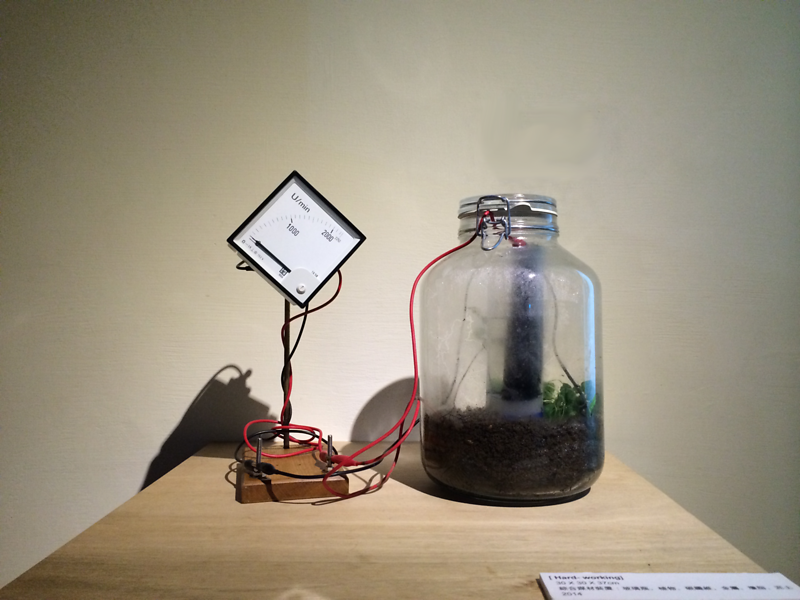


Lastly, some description of the work you presented in a recent Group Exhibition(?)


I am becoming more interested in bio electronics, so in developing a piece for a group exhibition focused on a theme of energy, I thought it was appropriate to make something based on the Thesis of Ruud Timmers and his work with microbial fuel cells. I have modified a VU meter based-on his research. When the plant is really producing a significant amount of electricity, the needle with point to the label reading something like, "we are working hard" or Hard Working.


Tuesday, April 9, 2013

@Resonate: Nomads and Coders

I have managed to find a few closing thoughts about the Resonate Festival, now that I found a moment, and some issues related to digital culture, the culture of technology, the culture of information and knowledge.

I would like to mention a man, an educator, who has figured out (or continues to figure [in process]) how to get his students to think and do code for a visually artistic result. Casey Raes is an artist. He is a programmer, perhaps even a crack programmer, but that doesn't really matter to him. In his presentation at Resonate, he made the distinction between be a painter, whose tools are brushes, paints, and canvas, and the artist whose studio is virtual. That is, the studio as a work-space for generating programs and software, or the software studio, the title of his talk. The end result of both of these types of artists, is more-or-less the same: an object with visual appeal that you can experience physically. It is certainly a nominal set of parameters by which to define art; and yes, I consider light pouring from a monitor to be a physical experience. However, programs that result in something physical, or embody a digital-to-analogue fabrication, are certainly nothing new to the art, or industrial production. The distinction is subtle, in lies in the tools' ability to reproduce work. Subtle, because a painting can be reproduced by someone else, or a production method could be designed digitally. My point being, I think is necessary for designers and artist to consider the act of coding. Coding is the tool, the means with which form, light and sound are shaped. I think this was implication from Resonate: you don't have to be a programmer to code.
I would go a step further to say, if you want to work effectively with media, how can you not be coding? All you need do, is look at the types and quality of work being produced today.

Let us take, for instance the great response of people who participated in the festival. At any given time, the Dom Omladine cultural space was buzzing with activity. If any complaint could be logged, it was that the space was not big enough. By my estimate, I would say that about half of the participants would not describe themselves programmers. Yet, you could say many of the presentations were about things that would appeal to the more technically inclined. Not to overly simplify the festival's intent, but the content, for the most part, embodied a culture that mostly programmers would consider interesting. It is hard to imagine coding could be considered such a spectacle, so then why such spectator interest? Are people programming passionate? syntax savvy? Or, just a little code curious?

Well, there is one thing we can assume, the community of coders continues to grow. And, even though the organizers from Magnetic Field B and the Creative Applications network do a fantastic job of lining up the guests, it still requires an active base of interest for people to attend an event. The overall size of such a community is perhaps be difficult to accurately gauge, by any account of numbers. In part, as Barry Threw mentioned previously (in a video tag for Latus Creativity), due to the shifting landscape of communities turning to, and cross-over from a large variety of tools. It is like taking the census for nomadic tribes, "Come back tomorrow, someone else will be living here." So we need to be unassuming about popularity; numeric data can be used in bad ways. (Anyway that is what Moritz Stefaner warned us about in his presentation.)  At any rate, the success of numerous open source initiatives from the past decade, is a testament to the waxing popularity of programming. And, that a culture which can be defined (almost entirely) by its will to self-organize around technological autodidacticism, is becoming something much more significant.

What that significance is, I don't think anyone is really sure. Though it is not a stretch of the imagination to see that the right of self-determination is implicit, and the necessity for sustainability latent. Or, it may be that the quality of creative output which is produced through programming tends to be new, fresh, and furthermore, effective at leaving a lasting impression. At any rate, how can young artists and designers not be inspired from so many interesting code-based projects out there? I am sure Resonate corrupted a few graphic designers into becoming self-deprecating hackers. From my perspective, I don't really understand this reluctance for designers-artists to be programming. Many disciplines require programming skills: Biology, Chemistry, Physics, Geology... They don't consider themselves programmers, they are just using the tools available. However, I also think there is a notion that this form of media creation is a bit subversive.

David Gauthier of CIID [Copenhagen Institute of Interaction Design] made a reference to the established academic institutions not being able to fund CIID because of the obscure nature of a highly interdisciplinary and morphic curriculum. Of course, there some exceptions to this perception, however, few. Mr. Gauthier went on to explain that they are able to sustain operations through consulting and research initiatives. Perhaps this interdisciplinary ambiguity, and perceived incompatibility with the paradigm of academia is a good thing. For all the wonders of an education, remember that schools and related enterprises have gatekeepers, and are, by and large, restrictive with the access of knowledge. This was really the point Aaron Swartz was making by downloading JSTOR papers from MIT servers. This is what open source initiatives would like to avoid.

It goes without saying, that we should remember open-source is not free. There are certainly degrees of sacrifice, and large amounts of dedication behind the convenience of information culture. Many platforms have to allocate resources to plan and perform maintenance and upgrades to insure maximum accessibility  For example, development of the Processing IDE is funded by the sales of the books authored by Mr. Reas.

I don't mention this to paint any one's coat the color of valor, but just to point out the fact that I am sure he is well aware you can find a digital copy of it anywhere for free. That is not the point. It is basically the honors system in which knowledge attained is value acquired. It is a gamble, but if you think about it, it is really the only way *all* of this is going to work out.