Showing posts with label installation art. Show all posts

Monday, June 2, 2014

Hsien Yu Cheng: the Collector

Hsien Yu Cheng is an artist, designer, and programmer. He provides hardware designs for artists working with technology and programs applications for iOS. But, most notable is his creative output of technology-based art. He begins by giving us a description of some of the works from his solo exhibition.

Well, I do many different things, and I am probably going about doing things the wrong way. I should become highly specialized, but I enjoy working with different media and languages. So, the result is an exhibition with the theme of Collector v1.0.0, or the objects that collect stuff. I have revived two older works. One is a web browser you can connect 88 mice to. All the mice can surf the internet and when there is no screen activity, the mice cursors come together to display Portrait 2013: Douglas Engelbart, inventor of the mouse. The second work is a new version of Afterlife.

I have two new pieces which collect more stuff. Like Half-Life, I have an object called 'Collect a Life' which is a robot that makes very loud noises and continues to do so until you put coins into it. Then, it becomes quiet and returns to its place. The second, is a re-make of a work called 'Out of Position' or Fish on Dish by an important Taiwanese artist, Yuan Goang Ming. His installation is a video of a swimming goldfish projected on a large white dish. My re-make is called Dish on Fish, in which a robot fish swims around on a projection of a large white bowl.

Additionally, I will issue a plug-in for Quartz Composer which allows you to program in real-time with OpenGL scripts. This could be useful for people working with multimedia design.

Because you work developing software and hardware for a variety of artists regionally, as well as yourself, can you explain what the relationship between art and technology means to others in the region of Taiwan? Is the process of creating art integrated with developing skills with technology?


Well, artists in Taiwan don't really build too much; that is why I am busy. I think this disconnection comes from the academic environment. They offer courses and degrees for new media, but it is something you or I would call video art or digital art, and maybe, there are a few artists who even build sound installations. But, even the term 'new media' is quite old already.  In general, there is not much engagement in artistic research for new media. Sometimes you will see simple electronics with lots of wires being very obvious that object is technical. You can not mistake the technological work with a more archaic approach. Regionally, I mostly see projects that are mixed media or traditional materials with no real interest in interaction. At the Taipei art exposition, I saw a Japanese artist presenting work that I saw my classmates in Holland working on and developing with more of a focused outcome. Perhaps he even saw the project on the internet and decided to make his own version. I can not be certain, but I am sure that technology tends to be viewed in the art-world as an after-thought.


"If they can see the soldiering, the wires, and the detail
...maybe they will see this part of the story."

When artists approach you, do you wear the hat of a designer; the one that strictly tries to resolve problems? Or, do you not distinguish the artist from designer, perhaps thinking how the projects you work on for others maybe be improved not just technically but artistically as well?

Ummm. I think there is a design process, but a different type of design process at work. If artists have difficulty working with technology, then they really will have difficulty understanding the design process. It is more likely they will not even get involved with process at all. But, maybe this is better.

I began working for artists at Mediamatic in Amsterdam. So, I understand how process can turn in any direction. We made things that we thought clients wanted, so the design choices were based-on meetings, and then more meetings with the client. And, more meetings still. When you finally present a prototype, you want it to be the best possible solution because the client does not always understand that there is a version control; with every subsequent view and use of the material, the design is potentially revised. At some point, you have to just go with it.

As a artist working with technology, the design process begins with the concept. You have to be flexible with materials, both hardware and software, as your knowledge increases with out abandoning your idea. However, it may be that your idea gets better, so you adapt to new decisions. It is more casual compared to the business of product design. 

Whether you are building a complete object or appropriating some consumer product, it is usual that you ask many companies for materials, such as internet searches through AliBaba. This alone is an interesting process. When you start to make something, you have to think so much through the process, that the process itself becomes designed.


As you say, design in the art process is different 
then product design because you don't have to go through the length and rigor to form an idea. If artwork does not have to conform to any particular standard, the standard is self-determined? 


Of course. If the design is for your own consideration, it has to be something that you are happy with. I want the stuff I make to look nice. When I choose the components for a project, I will not just think about the needs of the circuit, but the physical characteristics and the visual appeal of the object. Maybe, I want to have nice, big, older components. Something that is not necessarily defined by any time or place in particular. If I am purely a designer, I would ask a company to make my circuit and print a board. I know I will get something small and cost effective for quantity production. But, as a work of art, that is not what I want to present.

I try to think from the viewer's perspective, so I consider what the audience wants to see. I think hiding the electronics and wires away in a box also hides the process away from the audience.  Components are an important part of the composition and I like those visual characteristics. Seeing how things are put together gives the audience an opportunity to understand another layer of the work involved. If they can see the soldiering, the wires, and the detail of the components, then maybe they will see this part of the story.

Let us say we are looking at a coffee maker on display, and we did not know anything about a coffee maker. It is some thing clean-looking with no indication of what is inside. Without seeing any of the functioning parts, we might think the art work was purely conceptual. Basically, you show people what you think is important, and that all depends on your artistic disposition.

The other aspect of working with technology is that you have to have skills to make tools, and often. You make tools to build your ideas, and these tools can be shared and passed on. This is the essence of open source. I think this will be important as artists realize new levels of physical computing.
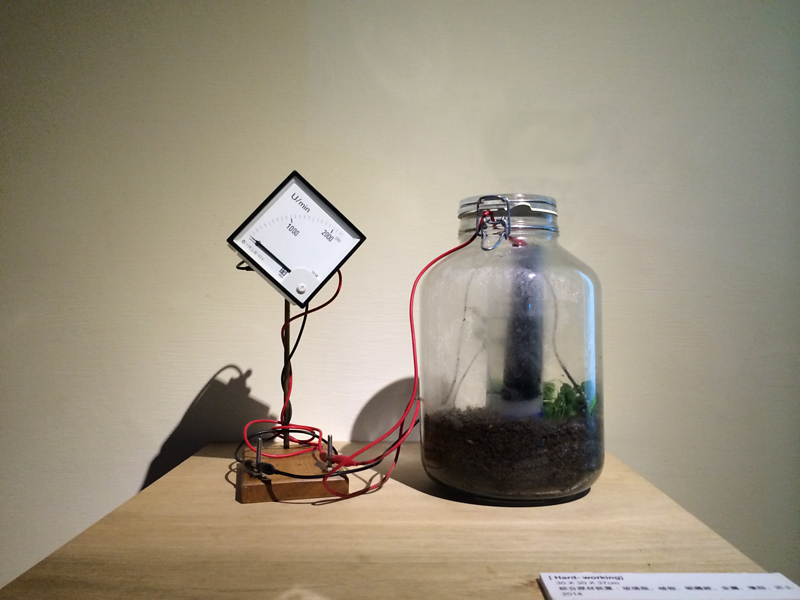


Lastly, some description of the work you presented in a recent Group Exhibition(?)


I am becoming more interested in bio electronics, so in developing a piece for a group exhibition focused on a theme of energy, I thought it was appropriate to make something based on the Thesis of Ruud Timmers and his work with microbial fuel cells. I have modified a VU meter based-on his research. When the plant is really producing a significant amount of electricity, the needle with point to the label reading something like, "we are working hard" or Hard Working.


Thursday, April 24, 2014

Nikhil Joshi: the MultiModal Narrative

Nikhil on-location
There is not a form of media which can aptly describe a reality of difference. One of the qualities of being human is the assumption that we know much more than we do; that all things can somehow fit into the framework of our culturally-biased reasoning and imagination. Although, if you consistently draw comparisons between cultures in order to give meaning to an experience, you will likely miss the underlying condition and the essential communication. This experience can be a frustrating mastication of ineffective words, which circle meaning, and never arrive. However, from this ambiguity, unassuming is the palate which can distinguish these flavors of humanity. Language is much more than words. But, that is why we have art.


Presently, the term Post-Digital is floating around the air. The basic effect of this term, is that the novelty of technology is wearing off, leaving us to (re)define that which has meaning. So then, what is an effective means of  communication within this expansive domain of media and even greater domain of meaning? In this context, India is interesting because it is a culture that has transformed radically within the last thirty years. Because of this rapid change, you are able to find a range of technologies juxtaposed. Part of this transformation includes a flow of western media containing messages of morality, ethics, trash films and unchallenged ideology. However, another part brings innovation, media production, design, and aesthetics. Academic programs and interactive design and production in India are still infantile, without any hint of design epistemology.  But, perhaps starting with a 'clean slate' is a timely advantage in the post-digital era?

I recently spoke with Nikhil Joshi, who is an artist working with technology and founding partner of Digital Jalebi. As a designer he is progressive and questioning, as an artist, sensitive to the evolution technology presents to the broader spectrum of the mass of culture called India. I asked about how culture has influenced his education and development with technology. 

One can be overwhelmed by the brilliance and expertise available to an Indian design student. I studied at the National Institute of Design  for 3 years. NID is a mixed bag of crafts inspired by design practices and technological innovation. Most of the courses find their way in the crafts found all across India, from glass work and jewelry design to toy design.  Some famous crafts are the glass work of  Ferozabad, wooden toys of Chennapatna [e.g. Maya Organic, Kaveri Crafts], and braiding from Karanataka.  The education process starts with inspiration from these artists and craftsmen, then moves toward contemporary design practices. Including, considerations for mass production, usability, and brand reflection.

Another factor which has detracted from the emergence of a particular contemporary style, is the lack of documentation of regional arts and crafts. NID has been trying to document and share works from different parts of the country for last 50 years, to make them available to the next breed of designers.Otherwise, this lack of documentation, backed by a culture of not-documenting-things, makes it very difficult for a style to grow and develop, so it is a blow to the the entire idea of opensource, as well as, research practices.


Technology can't be separated from culture, anyone's culture, I think this is a pre-requisite for selling that technology to people. But, you have provided some examples of how technology is changing concepts in art and design, but do you perceive a dilemma or paradox at work? Between your reality and the ideals propagated by the media (foreign or domestic)? 


This contrast doesn't really effect most of us who have lived and studied in cities, with a  high western impact. Our schools and academics have had a heavy western influence, and like us, most of the post-80's artists from cities are a result of Indian acceptance of digitization and technological advancements. We have seen TV sets go from a single channel to 1000+ channels.

Although, there is a heavy conflict when it comes to accepting technology as an expressive medium. Particularly from more experienced artists from the more under-privileged parts of India. Someone has correctly said, "It is very hard to unlearn". With the opening of western markets for Indian artists and craftsmen, there is an exposure for them to understand uniqueness as a fundamental need, but the entire design world from India is so new to the western markets, that it will still take another 15-20 years for them to strive for competitive uniqueness among themselves.

"Humans want to judge everything in good or bad, pleasure or pain, profit and loss."

Cross-culturally, the narrative is essential to all. It seems that many artists (analog or digital) in India reference traditional art forms. Are culturally established forms of the narrative particularly relevant to evolving artistic disciplines which use technology? And, what, if any, consequence does this have on an individual's identity?


If you look at an art school in the U.S., uniqueness has a relation with being the best. If you want to be the best, you need to be unique and spectacular to that effect. That is, how people judge you and that is how you judge yourself. I think this is linked with a core belief that is on a basic level in western society; you have only one life. You you have only one life, so you have to be the best now!


By contrast, culture in India accepts the idea of many life's or Janams; you have seven lifetimes. This aspect is something which is deeply rooted in us, spiritually and/or culturally. It is reflected in the arts and crafts all across India. They make things that are relevant to their culture, and they are likely to produce the exact same work throughout their entire life.

Technology today does help a lot in exploring ways towards creating more multi-modal experiences. So, the potential is not being fully realized, yet. But, narratives are very important to India. I think they are important to everyone, everywhere because any piece of information is contextualized by events. The cultural context creates patterns people can recognize and learn from. For instance, I was reading Ramayan the other day, where the Ram says, "Humans want to judge everything in good or bad, pleasure or pain, profit and loss." People create meaning out of narratives to form culture, and that forms their perception of the world.

When considering contemporary design, the idea of interactivity or an 'experience' is superficial in India. When I say superficial, that actually is not a question about the skill or the output but their intention of how much they want you to be a participant in the system. Most of the artifacts coming out of the interactive design process access fewer human senses then they are possible. So the point I am try to make here, is art or design was never meant to be multimodal in nature. It is as if these designers never thought of the ways they would invite people to participate, as well as the ways in which they could broaden and enhance their experience. Technology has played a major role in empowering artists/designer with tools to achieve multimodality. I think multimodality would just allow you to experience objects or events in more ways then just one singular way.


I don't know if I would agree that art was never meant to be multi-modal, but by making a comparison of superficial work, you must know of examples in which the relationship is between viewer and artifact is multi-modal? Work which the designer or artist approached the viewer as a participant?


This is the biggest difference I see in our approach today as new media artists; looking back at what people have already done or have mastered. Different artists in different domains are now trying to experiment with media and attach more senses to their creations. I think one of the best examples is the work of Nina Sabnani. She presents a very interesting way of telling stories that includes different sensory input. She narrates stories using a tangible art form where you flip open a structure with various faces and use it to tell stories: Kawad Storytelling Tradition. So, when you start putting music, texture, visuals all together in an interactive format, you are really expanding the playground for your viewers.


Nikhil and Digital Jalebi have recently been working on a project for the Kathputli Colony in Shadipur, Delhi, which involves the relocation of a community of artists and artisans in the wake of gentrification, likely to disenfranchise families that have worked for generations as performers. The project gives expression to the residents' hopes in realizing the colony's potential by focusing the viewer's attention on what they have to offer now. 


In an optimistic world, the performers of Kathputli Colony would, someday, have a chance to develop technology for their own performances. Maybe they would realize an original re-appropriation for technology which even technologists or academics could not think of(?) Cultural diversity has much more to offer humanity. Diversity has only ever allowed for a greater range of possible outcomes. 

India's culture is comprised of diverse range of micro-cultures. If it becomes standard practice to disenfranchise these cultures, what remains?